EL NINO AND LA NINA PHENOMENON
EL NINO AND LA NINA PHENOMENON
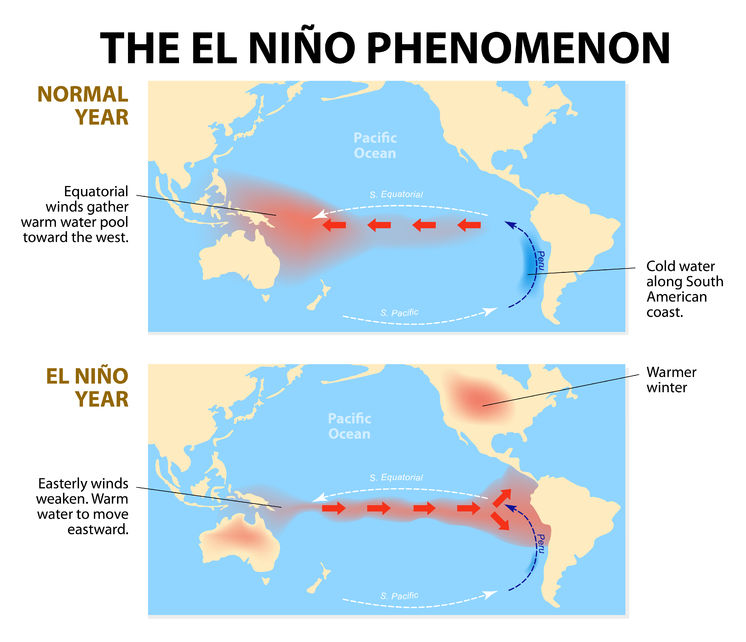
El Niño and La Niña are two opposite phases of the El Niño-Southern Oscillation (ENSO) cycle. During normal conditions in the Pacific ocean, trade winds blow west along the equator, taking warm water from South America towards Asia. To replace that warm water, cold water rises from the depths — a process called upwelling. These natural climate phenomena occur due to variations in sea surface temperatures in the Pacific Ocean, leading to shifts in weather conditions worldwide.
What is El Nino?
What is El Nino?
El Niño means Little Boy in Spanish. South American fishermen first noticed periods of unusually warm water in the Pacific Ocean in the 1600s. The full name they used was El Niño de Navidad, because El Niño typically peaks around December. During El Niño, trade winds weaken and warm water is pushed back east, towards the west coast of the Americas.
https://www.texasvox.org/wp-content/uploads/2016/04/El-Nino.jpg
El Nino Southern Oscillation (ENSO)
It is called El Nino Southern Oscillation. In normal times, when the tropical South Pacific Ocean experiences high pressure, alternatively the tropical Indian Ocean experiences low pressure conditions. However, these pressure conditions are sometimes reversed, and result in low pressure in the Pacific and alternatively high pressure in the Indian Ocean. This is the periodic change in pressure conditions which is referred to as the Southern Oscillation. These changes in the pressure conditions being developed in the Pacific and Indian oceans are connected with the phenomenon of El Nino. This connected phenomenon is referred to as the El Nino Southern Oscillations or the ENSO.
What is La Nina?
La Nina means ‘little girl’ in Spanish also called El Viejo or ‘cold event’. In this case, water temperature in the Eastern Pacific gets colder than normal. Due to this, there is a strong high pressure over the eastern equatorial Pacific. Hence, there is low pressure in the Western Pacific and off Asia. Because of this, the following events take place:
- Droughts in Ecuador and Peru.
- Heavy floods in Australia.
- High temperatures in the Indian Ocean, Western Pacific, and off the coast of Somalia.
- Good monsoon rains in India.
- La Nina years experience better than normal monsoons in India. La Nina is thus, beneficial for Indian Monsoons.
Impact
1. El Niño Weakens the Indian Monsoon
The Indian monsoon is driven by temperature contrasts between land and ocean, which create low-pressure systems that pull moisture-laden winds from the Indian Ocean. During El Niño, this system is disrupted due to abnormal warming of the central and eastern Pacific Ocean, leading to weaker monsoon circulation.
- Normally, warm air rises over the western Pacific (near Indonesia & India), creating strong convection and monsoon rains. During El Niño, warm water shifts eastward, reducing convection over the Indian subcontinent. As a result, cloud formation and monsoon intensity decrease, leading to deficient rainfall.
- El Niño weakens trade winds, which slows the transport of moisture from the Indian Ocean to the subcontinent. The sub-tropical jet stream shifts southward, suppressing monsoon depressions (low-pressure systems that bring rain).
- The Indian landmass usually heats up faster than the ocean, creating a strong low-pressure zone that attracts moisture-laden winds. During El Niño, Pacific warming weakens this contrast, leading to weaker winds and lower rainfall over India.
- The Indian Ocean Dipole (IOD) is a climate pattern affecting the Indian Ocean’s temperature gradient. A negative IOD (cool western Indian Ocean & warm eastern) often coincides with El Niño, further weakening monsoon rains.
- El Niño increases subsidence (sinking air) over India, reducing cloud cover and limiting rainfall. This leads to longer dry spells, droughts, and more heatwaves.
2. Global Climate Effects
- Global Warming Effect → Since El Niño releases vast amounts of heat from the ocean into the atmosphere, it contributes to temporary global temperature increases.
- Heatwaves → Many regions, including parts of Asia, Africa, and North America, experience extreme heat events.
- Colder Winters in Some Areas → Changes in the jet stream can lead to unexpected cold spells, particularly in parts of Europe and North America.
3. Disruption of Atmospheric Circulation
- Walker Circulation Weakening → Normally, warm air rises in the western Pacific (Indonesia, Australia) and cools in the eastern Pacific (Peru, Ecuador). During El Niño, this pattern weakens, affecting global wind patterns.
- Shift in Jet Streams →The subtropical jet stream moves southward, bringing more rain to the southern US and drier conditions to Southeast Asia. The polar jet stream is also affected, influencing storm paths in Europe and North America.
- Suppressed Trade Winds → Slower or reversed trade winds reduce upwelling (nutrient-rich cold water rising from the deep ocean), affecting marine life and fisheries.
4. Impact on Rainfall Patterns
- Heavy Rainfall & Flooding → Countries like Peru, Ecuador, Kenya, and parts of the southern US experience excessive rainfall and flooding.
- Droughts → Australia, India, Indonesia, and southern Africa face severe drought conditions due to reduced monsoon activity.
5. Impact on Agriculture
6. Impact on Fisheries & Marine Life
El Niño has a devastating effect on marine ecosystems, particularly fisheries that depend on stable ocean temperatures and nutrient availability. One of the most significant disruptions occurs in the eastern Pacific Ocean, where the warming of sea surface waters reduces upwelling—a process that brings nutrient-rich cold water from the deep ocean to the surface. This decline in upwelling results in lower concentrations of plankton, the foundation of the marine food chain, leading to the collapse of fish populations.
Peru and Ecuador, for instance, experience drastic declines in their anchovy fisheries, which are crucial for local economies and global fishmeal production. The scarcity of anchovies affects higher predators such as seabirds, seals, and larger fish, triggering a chain reaction throughout the ecosystem. In addition, many commercially valuable species like tuna, cod, and salmon alter their migration patterns in search of more suitable water temperatures, impacting fishing industries worldwide. Another major consequence is coral bleaching, caused by the rise in sea temperatures

Conclusion
El Niño and La Niña are powerful climate forces that shape global weather patterns, impacting agriculture, economies, and daily life. Monitoring these phenomena helps governments and communities prepare for their effects, mitigating risks associated with extreme weather conditions.


Very Informative
ReplyDeleteWell written
ReplyDeleteGood information
ReplyDeleteGreat info! Learnt a lot after reading!
ReplyDelete